Learn
Pharmacogenomics explained: how genes affect medication response
Pharmacogenomics studies how inherited variants can affect medication metabolism, effectiveness, or adverse-reaction risk. A pharmacogenomic test can help a clinician interpret some gene-drug relationships, but it cannot identify a universally “best” medicine. Coverage, laboratory quality, other medicines, health conditions, and clinical context still matter.
Published by DNA Layer · Sources reviewed 26 August 2026 · DNA Layer is discussed transparently · No independent medical review is claimedWhat pharmacogenomic testing can tell you
A pharmacogenomic test looks for covered variants that can help explain how a person processes or responds to certain medications. Depending on the gene-drug relationship, a result may inform a discussion about exposure, likely response, adverse-reaction risk, or dose. It does not test every medication, and it does not replace the clinical reason for treatment or the rest of a person’s medical history.
NHGRI describes pharmacogenomics as one input to medication and dose selection, not a way to identify a perfect drug. In one pre-emptive testing cohort of 9,589 patients, 91% carried at least one actionable genotype across the five drug-gene interactions implemented by that programme. That result shows why the field can matter; it is not a universal estimate for every panel, population, or medication.
Clinical pharmacogenomic test vs. consumer raw DNA file
A consumer genotype export can contain medication-related markers, but finding a row is not the same as receiving a validated clinical result. The exact file, platform, marker call, test coverage, and interpretation all matter.
| Question | Clinical pharmacogenomic test | Consumer raw DNA analysis |
|---|---|---|
| Primary purpose | Answer a defined health or medication question using the laboratory’s stated test scope. | Explore markers present in an export originally produced by a consumer genotyping service. |
| Coverage | Defined by the ordered test; the report should state what was and was not assessed. | Limited to the provider and chip version’s predetermined marker set, which can omit relevant variants. |
| Result quality | Interpreted within the test’s analytical and clinical validation claims. | Provider-specific. 23andMe says its raw data has general quality review but only a subset of markers is individually validated. |
| Decision use | Can inform care when the result, guideline, labeling, and patient context support it. | Informational starting point; medically important findings need appropriate confirmation and professional review. |
Can 23andMe or AncestryDNA raw data show medication response?
A consumer file may contain some pharmacogenomic markers. That can support a careful, bounded interpretation, but it cannot prove that the file covers every relevant variant or that an observed call is suitable for a medication decision. 23andMe explicitly distinguishes its raw genotype data from its own curated Pharmacogenetics reports and says the raw feature is informational, not medical.
NHGRI warns that third-party interpretation of consumer raw data can produce false positives and recommends clinical confirmation before healthcare decisions. A missing marker is also not reassuring: it may mean the chip did not test the relevant variant. Start with the exact provider file, keep its source and chip context attached, and treat the result as a question to investigate rather than an instruction.
How a gene-drug result becomes useful
- Confirm the measured genotype and coverage. A result is only as useful as the test that produced it; an absent row cannot be interpreted as a normal clinical result.
- Translate genotype into the supported phenotype. The relationship between a variant, gene function, and metabolizer or response group must be evidence-backed rather than inferred from a nearby marker name.
- Match the exact gene-drug relationship. Guidance for one medication cannot be generalized to every medicine processed by the same pathway.
- Add clinical context. Other medicines, health conditions, age, environment, adherence, and the treatment goal can all affect response.
CPIC guidance and FDA information answer different questions
CPIC publishes evidence-graded guidance for how a clinician can use an available genotype. CPIC explicitly says its guidelines address how to use a result, not whether a test should be ordered. That distinction prevents a guideline entry from being misread as a universal testing recommendation.
FDA’s pharmacogenetic association table and drug labels are another evidence layer. FDA notes that an association appearing in its table does not by itself mean the agency recommends testing before prescribing, except where an authorized companion diagnostic is required. The table is also not a complete prescribing resource; clinicians still need the current approved label and patient context.
How DNA Layer uses this data
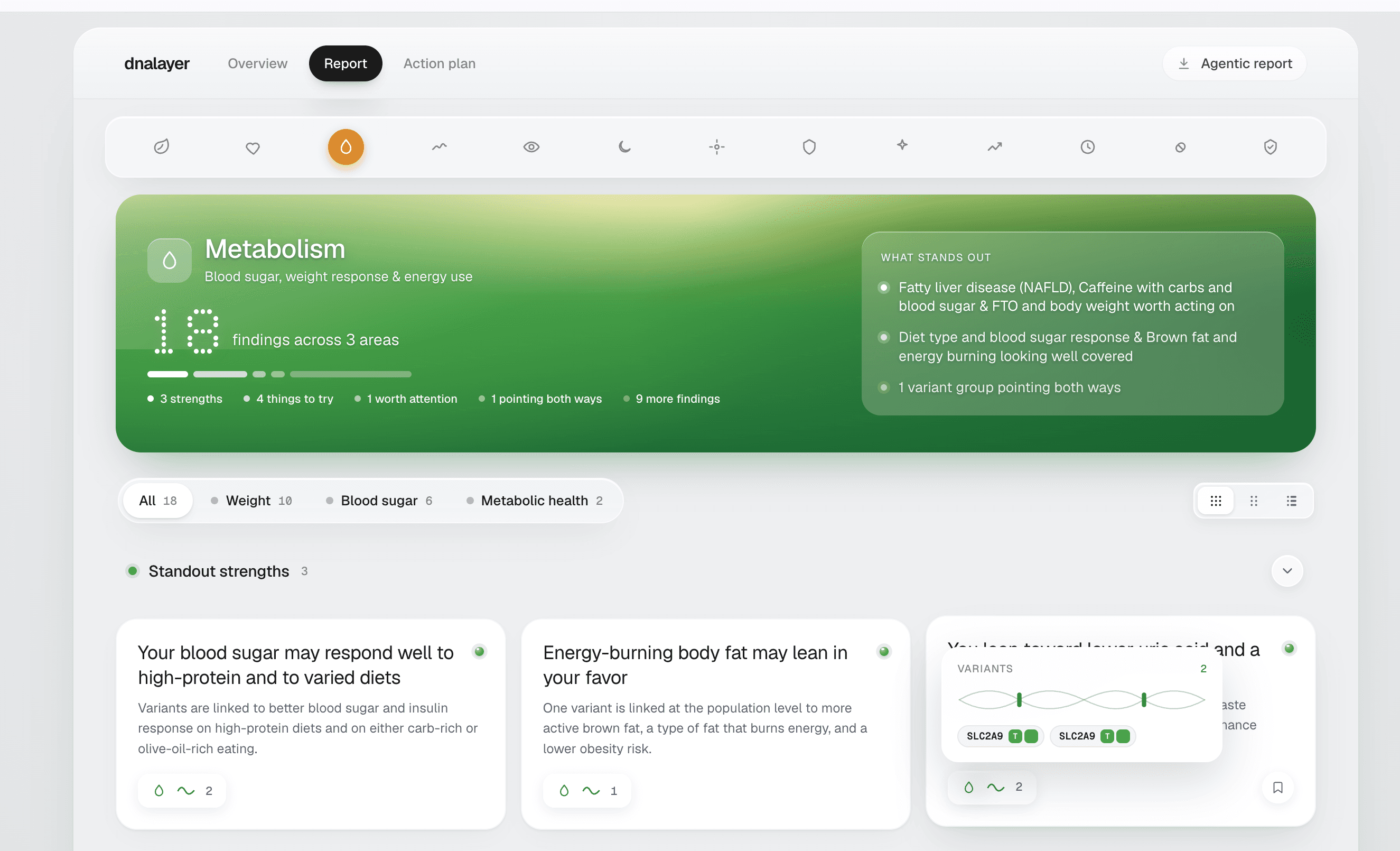
CPIC and PharmGKB are part of DNA Layer’s always-on clinical-grade safety floor, alongside ClinVar, ClinGen Actionability, and FDA pharmacogenomic labels. This floor is checked for every report regardless of which optional sources a given report enables, can only raise a finding’s flagged severity (never lower it), and never invents a finding — so a real prescribing-relevant result is never understated. See how DNA Layer builds your report for the full methodology.
DNA Layer is still an informational consumer product, not a clinical pharmacogenomic laboratory. Its job is to preserve the evidence, coverage, and confirmation boundaries beside a finding so the result is safer to discuss with a qualified professional.
What a pharmacogenomic result cannot settle
A pharmacogenomic result is not a diagnosis, prescription, or guarantee of benefit or harm. It cannot account for every relevant variant, medicine, interaction, health condition, or reason a treatment may succeed or fail. Never start, stop, switch, or change the dose of a medication based on a consumer genetic report. Bring the exact result and its coverage to a qualified healthcare professional.
Sources
- NHGRI: Pharmacogenomics Fact Sheet
- Van Driest et al.: actionable genotypes among 10,000 patients
- CPIC: clinical pharmacogenetics guidelines
- FDA: Table of Pharmacogenetic Associations
- FDA: direct-to-consumer tests and pharmacogenetics limitations
- NHGRI: direct-to-consumer raw-data interpretation and clinical confirmation
- 23andMe: raw genotype data technical details and limitations
- DNA Layer: evidence and safety methodology
- DNA Layer: privacy policy
- DNA Layer editorial and evidence standards
Frequently asked questions
What can pharmacogenomic testing tell you?
A pharmacogenomic test can identify covered variants that may affect medication metabolism, exposure, effectiveness, or adverse-reaction risk. It does not choose a universally best medication. A clinician still needs the test's coverage, current guidance, other medications, health conditions, and the reason for treatment.
Can 23andMe raw DNA be used for pharmacogenomics?
A 23andMe raw export may contain some pharmacogenomic markers, but it is not the same as a 23andMe Pharmacogenetics report or a clinical pharmacogenomic test. 23andMe says only a subset of raw markers is individually validated, so any medically important result needs appropriate confirmation.
Does pharmacogenomics tell you the best medication?
No. NHGRI explains that pharmacogenomics cannot identify a perfect medication. It can help a clinician compare some options or doses for supported gene-drug relationships, while response can also depend on other medications, health conditions, environment, lifestyle, and medical history.
What is the difference between CPIC and FDA pharmacogenomic information?
CPIC guidelines explain how clinicians can use an available genotype for a covered gene-drug pair; they do not decide whether testing should be ordered. FDA tables and approved labels describe regulatory evidence and labeling, but an association's presence does not automatically mean testing is recommended before prescribing.
Can a normal raw-DNA result rule out a medication problem?
No. A consumer file tests a predetermined marker set and may omit relevant variants. Medication response also depends on non-genetic factors. A missing or typical-looking raw-data result therefore cannot prove that a medicine will work, be tolerated, or require no monitoring.
Should I change medication based on a raw-DNA report?
No. Do not start, stop, switch, or change the dose of a medication based on a consumer raw-DNA report. Bring the exact result, source, and test coverage to a qualified healthcare professional, who can decide whether clinical confirmation or another test is appropriate.