Raw DNA interpretation
Raw DNA health report: what your data can and cannot show
Direct answer: A raw DNA health report can turn supported genotype calls into evidence-linked context about selected traits, carrier findings, medication response, and health associations. It cannot diagnose disease, recover variants your test never measured, or predict your future. Quality depends on correct parsing, allele alignment, current evidence, visible limitations, and clinical confirmation when consequential.
Published by DNA Layer · Evidence, product behavior, and primary sources reviewed 26 August 2026 · No independent medical review is claimed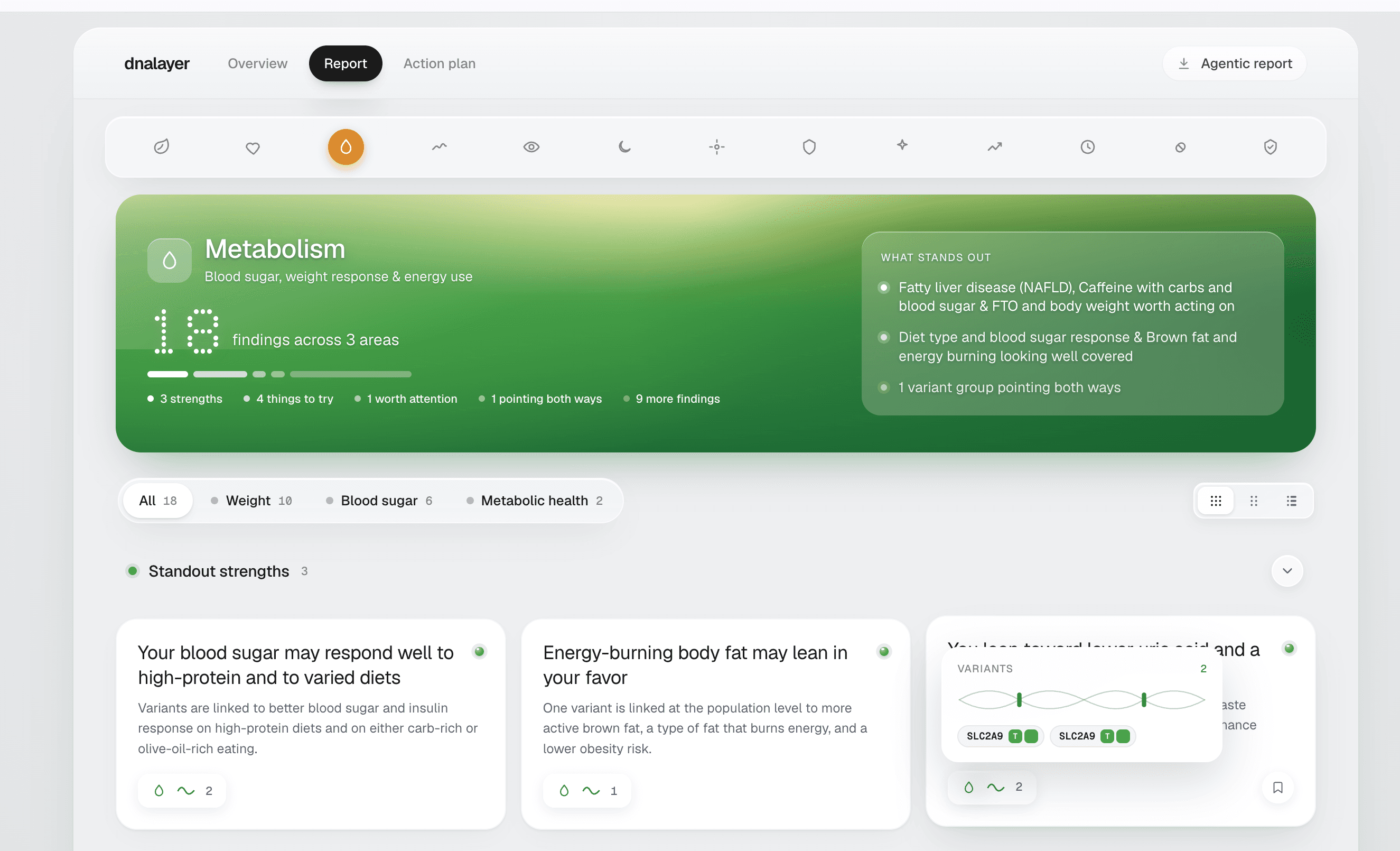
What raw DNA data can tell you
A raw file tells you which allele letters the testing array called at the positions it measured. After correct normalization and evidence matching, some of those calls can support useful findings about common traits, medication response, carrier status, clinically classified variants, or population-level associations.
The useful answer is always narrower than “everything in your genome.” Coverage depends on the provider and chip version, evidence differs in strength, and many outcomes depend on multiple genes plus environment, lifestyle, family history, and chance.
Choose the path that matches your file
Provider and chip version determine which positions are available. Start with the exact path for your existing export: 23andMe raw DNA analysis, AncestryDNA health analysis, or MyHeritage raw DNA health analysis. Each page separates the provider’s own reports from independent analysis and explains its file-specific limits.
What the file cannot tell you by itself
- Whether you currently have a disease or will inevitably develop one.
- Whether an unlisted variant is absent rather than simply untested.
- Your complete medication response or the right treatment for you.
- What a finding means for a relative who has not been tested.
- Whether a consequential consumer call is clinically confirmed.
What is inside a consumer raw DNA file?
Files from services such as 23andMe, AncestryDNA, and MyHeritage usually contain a long table of genotypes. A row commonly names a marker with an rsID, locates it by chromosome and coordinate, and records the allele letters observed at that position.
Those letters are uninterpreted. The same raw call can be irrelevant, weakly associated with a trait, useful for medication guidance, or important enough to investigate clinically. The difference comes from the evidence and context applied after parsing—not from how striking the gene name looks.
Worked example: why one row is not yet a result
Consider this deliberately illustrative row. It is a format example, not a real person’s data or a medical finding. Each stage adds information that the raw call does not contain by itself.
| Stage | Illustrative input | What can responsibly be concluded |
|---|---|---|
| Raw call | rs[variant] · chr 1 · [position] · A/G | The provider reported two allele letters at a labelled position. |
| Normalize | Provider, chip version, genome build, and strand | The call can be aligned to the intended reference before comparison. |
| Match evidence | Exact variant, effect allele, source, and evidence type | An association, clinical classification, and drug guideline remain distinct. |
| Report decision | Evidence strength, applicability, coverage, and limitations | Show a contextual finding—or show nothing when the support is insufficient. |
What a responsible raw DNA health report should include
| Check | What the report should show | Warning sign |
|---|---|---|
| File fit and coverage | The provider, build, markers found, and questions the file cannot support. | Assuming every provider or chip version measures the same positions. |
| Variant identity | The exact marker and allele after build and strand normalization. | Interpreting a gene name or rsID without verifying the observed allele. |
| Evidence | Named sources, evidence type, strength, applicability, and update context. | A long result list with no citations or distinction between evidence types. |
| Limits | Missing variants, ancestry or population limits, uncertainty, and false-positive risk. | Deterministic predictions or reassurance from an absent marker. |
| Clinical boundary | When confirmation and a qualified professional are appropriate. | Treatment, medication, or screening changes from a consumer call alone. |
| Privacy | What leaves the device, what is retained, who can access it, and how deletion works. | A generic “anonymous” or “secure” claim without the underlying data flow. |
Use the private DNA analysis checklistto compare those data-handling claims, or go straight to the supported-file preview when you are ready.
Seven checks from row to responsible finding
- 1
Identify the source and file type
Record which testing service and kit produced the file. Different providers test different marker sets and may use different layouts.
- 2
Read each row as data, not a conclusion
A typical row contains an rsID, chromosome, position, and genotype. Those fields identify a call; they do not by themselves establish a health effect.
- 3
Resolve genome build and strand
Coordinates can refer to different genome builds, and allele letters can be reported from opposite DNA strands. A responsible pipeline normalizes these before matching evidence.
- 4
Match the exact variant to current evidence
Check the same variant and allele against appropriate sources, then distinguish clinical classifications, drug guidance, population associations, and preliminary research.
- 5
Add context and limitations
Evidence strength, population, effect size, file coverage, age, family history, environment, and lifestyle can all change what a result means.
- 6
Prioritize instead of listing everything
Separate well-supported, potentially actionable findings from common traits, weak associations, and markers whose meaning is uncertain.
- 7
Confirm important findings clinically
Do not change treatment or screening from a consumer raw-data call alone. Clinically significant results may need confirmation in a qualified laboratory and review by a professional.
Why searching one SNP is not enough
A database entry or paper may describe a real association without showing that the effect is large, causal, replicated across populations, or useful for a decision. Other variants, environment, and lifestyle still matter. The FDA notes that direct-to-consumer services can test different variant sets and may disagree about interpretation.
Negative results also need care. A provider may test only some of the variants relevant to a condition. MedlinePlus warns that incomplete testing can create false reassurance, while raw-data interpretation can also produce false positives that need confirmation.
What DNA Layer automates
DNA Layer detects the supported file format, normalizes its markers, and performs deterministic matching against a curated evidence layer. Clinical sources act as a safety floor, and language models explain the verified finding rather than guessing directly from the raw file. The full methodology describes the evidence and safety boundaries.
The result is organized by health area and evidence strength instead of presented as an undifferentiated list of every marker that appears in a database. You can inspect a free preview before deciding whether to unlock the full layer.
What leaves the browser, and what is retained
In DNA Layer’s browser upload flow, the original raw file is read on your device. The supported marker data and technical metadata needed to build the layer are sent for analysis; the original file is not intentionally retained. Derived findings, evidence records, and generated guidance remain private to your account so you can return to them. Read the exact commitments in the privacy policy.
When to take a finding to a professional
Escalate when a result could affect treatment, medication, screening, reproductive decisions, or a serious inherited condition. A genetic counselor or appropriately qualified clinician can consider family history and select confirmatory testing. A separate guide explains what a DNA result can and cannot mean for relatives. Do not start, stop, or change medication from a consumer raw-data interpretation alone.
Frequently asked questions
What can raw DNA data tell you?
It can show genotype calls at the positions a provider tested. With careful evidence matching, those calls can support some trait, medication-response, carrier, clinical-classification, and population-association findings. It cannot diagnose a condition, cover variants the array did not test, or predict your future on its own.
What is an rsID in a raw DNA file?
An rsID is a reference identifier for a genetic variant, such as rs1801133. It helps databases refer to the same variant, but the rsID alone does not tell you which genotype you have or what it means.
Why can two DNA interpretation services disagree?
They may read different markers, normalize builds or strands differently, use different evidence sources, apply different classification rules, or update evidence on different schedules.
Does a missing marker mean I do not have the variant?
No. It may simply mean the provider did not test or report that position. Absence from a consumer file is not proof of biological absence.
Can raw DNA data diagnose a disease?
No. Consumer raw data and third-party interpretation are informational. Disease diagnosis depends on the clinical question, appropriate testing, confirmation, and professional interpretation.
How does a raw DNA row become a health finding?
A responsible service identifies the file source, normalizes genome build and strand, matches the exact variant and allele to current evidence, grades the evidence and limitations, and only then decides whether a finding is strong enough to show. The raw row alone is not a health conclusion.