DNA privacy buyer’s guide
Private DNA analysis: how to compare raw-data services
Direct answer: A private DNA analysis service should minimize what leaves your device, explain what raw and derived data it retains, limit who can access it, forbid undisclosed secondary use, and provide deletion controls. Privacy does not prove medical accuracy: consumer raw-data findings remain informational and consequential results may require clinical confirmation.
Published by DNA Layer · Product behavior, public policies, and primary sources reviewed 26 August 2026 · DNA Layer is included transparently · No independent medical or security audit is claimed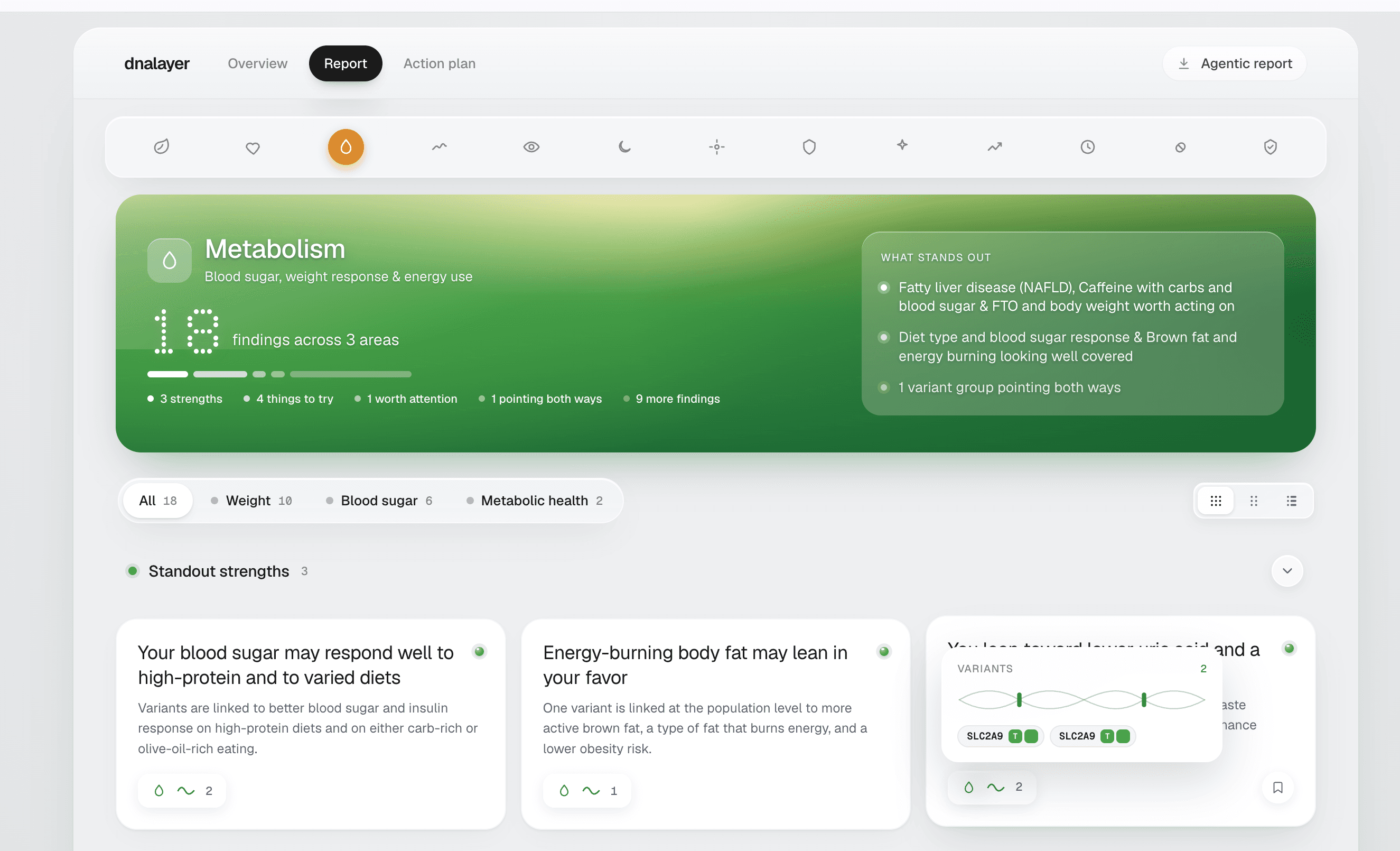
Start with the data flow, not the slogan
A raw DNA export can contain hundreds of thousands of genotype calls. The Federal Trade Commission advises people to check who can access genetic information, how it is protected, and how a company may use it. NHGRI makes a second point that is easy to miss: after you download your data and send it elsewhere, the original testing company is no longer responsible for that copy.
Before uploading, get clear answers to these five questions:
- Upload: does the whole raw file leave your device, or is it filtered locally first?
- Retention: are the raw file, a report, derived markers, or all three kept?
- Secondary use: can data be sold, shared, used for research, or used to train a model?
- Access: can staff, app developers, laboratories, or other processors see it?
- Deletion: can you delete the account and every retained genetic artifact without contacting support?
“De-identified” is useful, but it is not the same as harmless
Removing a name and email lowers risk, but genetic information can still be unusually identifying. The UK Information Commissioner’s Office explains that a set of genetic markers may still identify a person even when the name is gone. Treat the privacy policy, retention design, and account controls as one system rather than accepting a single “anonymous” label.
Published privacy models compared
Our dated source matrix records what seven services say publicly about original-file flow, raw and derived-data retention, material access, and deletion. It is not an independent security audit and does not calculate a winner; each row comes from the shared evidence owner used by the full research page and downloadable JSON.
| Service | Original-file flow | What remains | Deletion documentation |
|---|---|---|---|
| DNA Layer | Read locally in the browser; the original full file is not intentionally retained by DNA Layer. | Raw file: Original raw file not retained in the browser-based upload flow. Report or derivatives: Supported marker data, evidence records, and generated findings are stored privately for account access. | Deletion is available by request; data no longer needed is deleted or irreversibly de-identified, subject to legal needs and normal backup expiry. |
| Genetic Lifehacks | The membership workflow reads the selected raw-data file in the browser; the service says it is not transmitted to or stored on its server. | Raw file: The membership workflow keeps data in the browser's temporary cache until the user clears it; separate consultation and cheat-sheet workflows have different offline retention terms. Report or derivatives: Membership topic reports are generated in the browser; the cited pages do not describe server-side storage of the member's genetic data or generated topic report. | The member can use Clear Your Data to remove the browser-cached file. For separate consultation work, the policy says files are generally deleted after 30 days and member cheat-sheet files within a few days. |
| Promethease | The DNA file is uploaded to Promethease servers to generate a one-time report. | Raw file: Deleted after report generation; an upload without a generated report is automatically deleted after 24 hours. Report or derivatives: The server copy of the report is deleted after it is emailed; account information remains while the account exists. | Promethease and MyHeritage accounts can be deleted, but each account must be deleted separately. |
| Genetic Genie | The DNA file is uploaded to a Genetic Genie server and de-identified there. | Raw file: Deleted within 24 hours and usually immediately after processing, according to the cited product page. Report or derivatives: Generated PDFs and other files are not stored for more than 24 hours. | Automatic file deletion is stated; a separate self-service deletion control is not stated on the cited product page. |
| Sequencing.com | The DNA file is uploaded to and stored in a Sequencing account. | Raw file: Raw data remains in the account until the user deletes data or the account. Report or derivatives: Reports and derived results can remain available in the account. | Account deletion is available in settings. Research already completed and legally required laboratory or deletion records can remain under the policy's stated exceptions. |
| SelfDecode | A raw genotype file is uploaded to the SelfDecode platform and stored with the account to generate and retain personalized insights. | Raw file: The privacy policy says genetic information is retained while the account is open or until the user requests account and data deletion. Report or derivatives: Interpretations and analyses are available through the account; aggregated genetic information may be used for research, product development, and promotional purposes under the stated consent terms. | Deletion requires an emailed, confirmed request. Stored genetic, laboratory, and self-reported information is discarded, while completed research and legally required records may remain. |
| Genomelink | Raw DNA data is uploaded directly or imported from a supported DNA service and processed in a Genomelink account. | Raw file: The policy treats raw data as account Genetic Information and states no automatic deletion window; users can request deletion through the privacy portal. Report or derivatives: Trait analyses and account information remain available as part of the service. De-identified genetic and self-reported information may enter Genomelink Research only with consent. | The policy says account, raw data, and personal information are deleted within 30 days of a portal request, with ordinary backup-cycle, legal, completed-sharing, and user-copied-content qualifications. |
Read the recording rules, limitations, material-access column, and every source.
How DNA Layer handles the file
DNA Layer reads the original consumer DNA file locally in the browser. The original file is not retained. Only supported marker derivatives needed for analysis cross the boundary, and the resulting derived findings are stored so the user can return to the layer. DNA Layer does not sell genetic data, and users can delete their stored results and account data.
That is a specific architecture, not a promise that analysis is anonymous or risk free. Derived findings are still sensitive. They are kept private and account-scoped, and the exact commitments are set out in the privacy policy.
Use the matching provider path for file-specific coverage and limitations: 23andMe raw DNA analysis, AncestryDNA health analysis, or MyHeritage raw DNA health analysis.
Privacy does not prove medical validity
A service can have strong privacy controls and still overinterpret a consumer file. Raw genotyping data is not comprehensive clinical sequencing. NHGRI warns that third-party interpretation can produce false positives, so a result that could affect treatment, screening, medication, or reproductive planning needs suitable clinical confirmation.
To apply the checklist, see the dated privacy matrix in our guide to the best 23andMe raw-data analysis tools for different goals. It compares seven services using official public documents and makes its source data available as JSON and CSV.
Frequently asked questions
What makes a DNA analysis service private?
Look beyond a general privacy claim. Check whether the original file leaves your device, what derived data is retained, who can access it, whether it is sold or used for research or advertising, how deletion works, and what happens after an acquisition or closure.
Is de-identified DNA data anonymous?
Not necessarily. Genetic data can remain identifying because a genome contains many distinctive markers. The UK Information Commissioner’s Office treats genetic data used to identify a person as special-category data, including where a name has been removed but the markers remain sufficiently distinctive.
Does DNA Layer upload my original raw DNA file?
No. DNA Layer reads the original file locally in your browser and does not retain it. It sends only the supported marker derivatives needed to build your layer, then stores the resulting derived findings so you can return to them.
Can a private DNA report diagnose a condition?
No. Privacy and clinical validity are separate questions. Consumer raw-data interpretations can be incomplete or false positive, so important findings may require confirmation through an appropriate clinical laboratory and review by a qualified professional.
Sources
- U.S. Federal Trade Commission: Keep people’s sensitive DNA information private
- National Human Genome Research Institute: Privacy in Genomics
- UK Information Commissioner’s Office: genetic data as special-category data
- National Human Genome Research Institute: direct-to-consumer raw-data interpretation
- DNA Layer: privacy comparison methodology and source matrix
- DNA Layer: privacy policy
- DNA Layer: evidence and safety methodology
Analyze the file you already have, with the original kept off our servers.
How DNA Layer’s raw-file handling worksChoose your DNA provider