Source-checked comparison
Best 23andMe raw data analysis tools: how to choose
No single raw DNA upload site is best for everyone. DNA Layer prioritizes supported health findings; Promethease builds a SNPedia-linked literature report; Genetic Genie focuses on methylation and detox panels; Sequencing.com offers a stored genome and app marketplace. Check provider compatibility, output, clinical limits, cost model, and file retention before uploading.
Published by DNA Layer · Product descriptions, compatibility, and public policies reviewed 26 August 2026 · DNA Layer is included transparently · No independent medical review is claimedFour tools, four different jobs
This table is based on each service’s current public description and privacy policy. It avoids volatile prices and does not rank affiliate payouts. DNA Layer is included transparently as our own product.
Provider and file compatibility
Compatibility should be checked before usefulness: a service cannot interpret a marker that is absent from the uploaded file. These entries record examples each service explicitly documents; they are not a promise that every chip version or marker will produce the same coverage.
| Tool | Explicitly documented inputs | Boundary to check |
|---|---|---|
| DNA Layer | Original 23andMe, AncestryDNA, and MyHeritage ZIP or text exports; TellMeGen support is newer and less tested. | Consumer raw-data exports only. PDF reports, screenshots, GEDCOM files, ancestry coordinates, VCF, WGS, and WES are not currently supported. |
| Promethease | Its current report page names 23andMe, Ancestry, FamilyTreeDNA, and Genos, and shows 23andMe and Ancestry sample reports. | It builds a SNPedia-linked informational report; it does not claim that every source file contains the same variants. |
| Genetic Genie | Its Detox page names AncestryDNA, 23andMe, MyHeritage, FTDNA, Living DNA, HomeDNA, WeGene, 23Mofang, and others, plus VCF-formatted WGS/WES. | The cited output is a focused Detox profile, not an exhaustive consumer health report. |
| Sequencing.com | Its upload documentation names 23andMe, AncestryDNA, MyHeritage, FamilyTreeDNA, sequencing providers, and formats including VCF, BAM, and FASTQ. | Compatibility is platform-level; output, permissions, and cost can differ by marketplace app. |
| Tool | Best suited to | Output and limitation | Raw-file handling stated by service |
|---|---|---|---|
| DNA Layer | Prioritized health areas, evidence context, limitations, and an action plan. | Curated supported findings rather than an exhaustive SNP dump; informational, not diagnostic. | Original file read locally and not retained; supported marker derivatives and resulting findings are kept privately. |
| Promethease | Searching and browsing literature entries linked through SNPedia. | Large literature-retrieval report; the service says it is not for clinical use. | Policy says the DNA file and report are deleted immediately after the report is emailed. |
| Genetic Genie | Focused Methylation and Detox profiles. | Narrow pathway-oriented reports, not a complete health interpretation. | Service says uploads are de-identified server-side and deleted within 24 hours; staff may occasionally view data to improve the service. |
| Sequencing.com | A stored genome account and marketplace of analysis apps. | Output varies by app; evaluate the specific marketplace publisher as well as the platform. | Raw data and reports can remain in the account until deletion; selected marketplace apps may share needed DNA data with their publisher. |
Choose by the question you want answered
- “What deserves my attention?” Look for prioritization, evidence strength, limitations, and visible next steps.
- “What has ever been written about this SNP?” A literature-retrieval browser is a closer fit.
- “What does this pathway report say?” A focused methylation or detox tool may be enough.
- “I want many apps from one stored genome.” Compare marketplace permissions app by app.
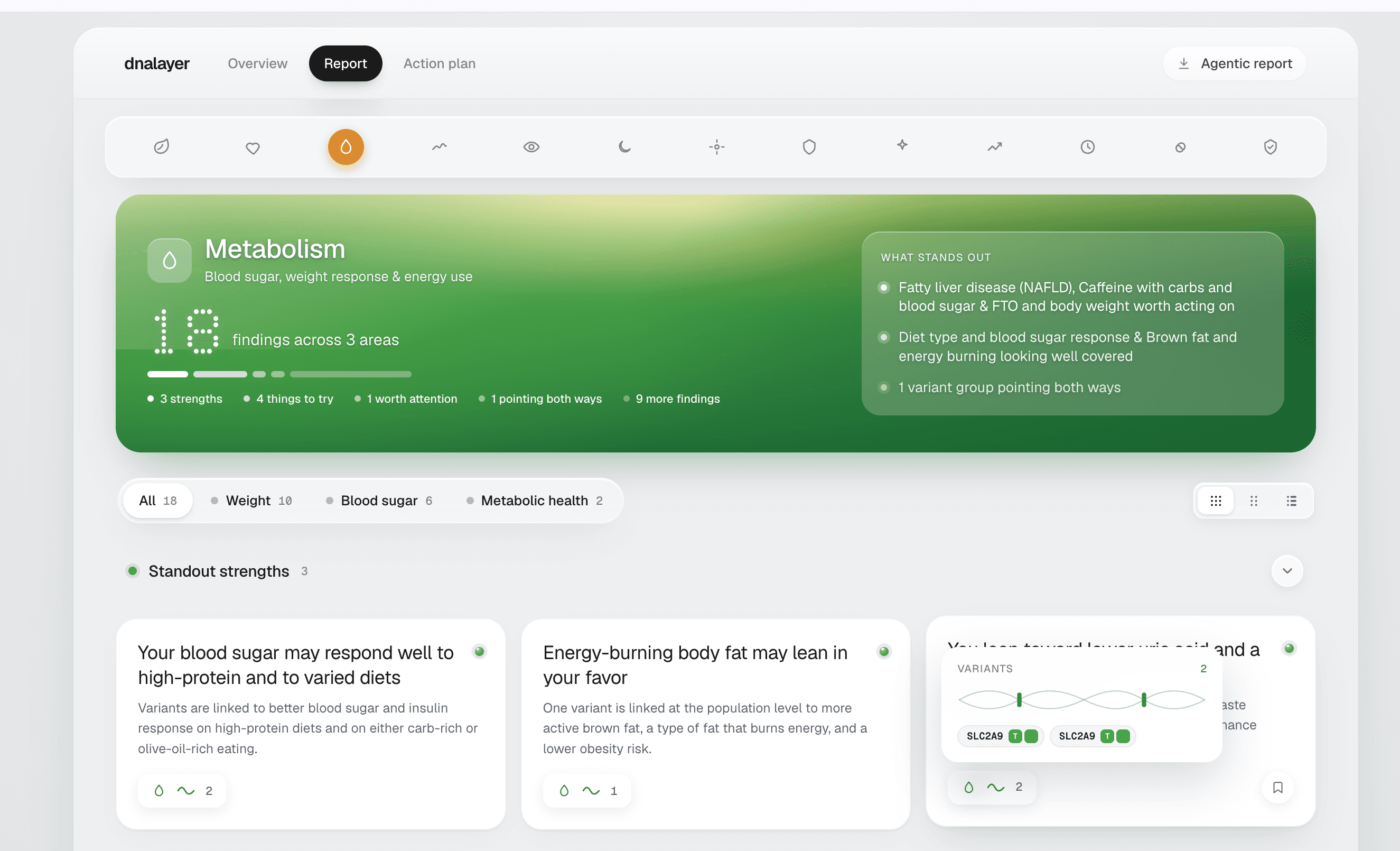
DNA Layer is built for the first job. It uses deterministic parsing and evidence matching before language-model explanation, so the model does not guess what the raw file contains. See the full methodology and a representative report view.
Check privacy separately from usefulness
23andMe’s own portability guidance warns that third-party services may use data under different terms. Ask whether the full file leaves your device, how long it remains, whether a marketplace developer receives it, and what deletion actually removes. Our private DNA analysis checklist gives a reusable way to compare those claims.
Privacy comparison: what the services actually document
We reviewed the current official product and privacy documents on 26 August 2026. The four-service shortlist above compares distinct product jobs; this extended seven-service matrix adds Genetic Lifehacks, SelfDecode, and Genomelink for a broader view of file-handling models. It separates the original raw file from reports and derived genetic data, because “we delete your upload” does not necessarily mean that every genetic artifact disappears. It is a comparison of published commitments, not an independent security audit.
| Service | Does the full file leave the device? | What remains? | Material access documented | Deletion path and limits |
|---|---|---|---|---|
| DNA Layer | Read locally in the browser; the original full file is not intentionally retained by DNA Layer. | Raw file: Original raw file not retained in the browser-based upload flow. Report or derivatives: Supported marker data, evidence records, and generated findings are stored privately for account access. | Specialist service providers may process data to operate the service; identifiable genetic data is not shared with advertisers or data brokers. | Deletion is available by request; data no longer needed is deleted or irreversibly de-identified, subject to legal needs and normal backup expiry. |
| Genetic Lifehacks | The membership workflow reads the selected raw-data file in the browser; the service says it is not transmitted to or stored on its server. | Raw file: The membership workflow keeps data in the browser's temporary cache until the user clears it; separate consultation and cheat-sheet workflows have different offline retention terms. Report or derivatives: Membership topic reports are generated in the browser; the cited pages do not describe server-side storage of the member's genetic data or generated topic report. | The membership workflow says Genetic Lifehacks does not receive or view the file. A separate consultation or cheat-sheet order requires sending genetic data under separately disclosed handling terms. | The member can use Clear Your Data to remove the browser-cached file. For separate consultation work, the policy says files are generally deleted after 30 days and member cheat-sheet files within a few days. |
| Promethease | The DNA file is uploaded to Promethease servers to generate a one-time report. | Raw file: Deleted after report generation; an upload without a generated report is automatically deleted after 24 hours. Report or derivatives: The server copy of the report is deleted after it is emailed; account information remains while the account exists. | Service providers may process data; the policy says DNA information is not sold, licensed, or shared without explicit consent except stated service, legal, and business-transfer cases. | Promethease and MyHeritage accounts can be deleted, but each account must be deleted separately. |
| Genetic Genie | The DNA file is uploaded to a Genetic Genie server and de-identified there. | Raw file: Deleted within 24 hours and usually immediately after processing, according to the cited product page. Report or derivatives: Generated PDFs and other files are not stored for more than 24 hours. | The product page says data is not shared, but staff may occasionally look at data to improve the service. | Automatic file deletion is stated; a separate self-service deletion control is not stated on the cited product page. |
| Sequencing.com | The DNA file is uploaded to and stored in a Sequencing account. | Raw file: Raw data remains in the account until the user deletes data or the account. Report or derivatives: Reports and derived results can remain available in the account. | Authorized personnel and service providers may have limited access; a marketplace report can send the necessary portion of personal information to its third-party developer after authorization. | Account deletion is available in settings. Research already completed and legally required laboratory or deletion records can remain under the policy's stated exceptions. |
| SelfDecode | A raw genotype file is uploaded to the SelfDecode platform and stored with the account to generate and retain personalized insights. | Raw file: The privacy policy says genetic information is retained while the account is open or until the user requests account and data deletion. Report or derivatives: Interpretations and analyses are available through the account; aggregated genetic information may be used for research, product development, and promotional purposes under the stated consent terms. | Service providers may process genetic information; DecodyGPT users consent to masked and anonymized data being sent to OpenAI. Individual-level genetic information is otherwise limited to service providers unless the user gives explicit consent. | Deletion requires an emailed, confirmed request. Stored genetic, laboratory, and self-reported information is discarded, while completed research and legally required records may remain. |
| Genomelink | Raw DNA data is uploaded directly or imported from a supported DNA service and processed in a Genomelink account. | Raw file: The policy treats raw data as account Genetic Information and states no automatic deletion window; users can request deletion through the privacy portal. Report or derivatives: Trait analyses and account information remain available as part of the service. De-identified genetic and self-reported information may enter Genomelink Research only with consent. | Service providers receive data needed to operate the service. Research collaborators require explicit consent; the optional DNAsolves program separately shares a user's name and genetic information with Othram and may compensate Genomelink. | The policy says account, raw data, and personal information are deleted within 30 days of a portal request, with ordinary backup-cycle, legal, completed-sharing, and user-copied-content qualifications. |
Explore the complete methodology and source matrix, or download the versioned JSON or CSV data.
How to read the matrix
- Local parsing reduces one boundary. It does not make stored derived findings non-sensitive.
- Automatic deletion and account deletion are different. Check what happens to the upload, the report, account records, backups, and completed research.
- “Not stated” is not an accusation. It means the cited public page did not give us enough evidence to claim a control exists.
- No overall winner is calculated. The reviewed local-processing, automatic-deletion, and account-retention models serve different jobs and do not establish medical quality.
What “free DNA analysis” actually includes
A free upload is not a standardized product category. DNA Layer provides a free personalized preview after it checks the supported markers in the file; the full health layer and action plan are paid. Promethease’s current product page lists a one-time report price and a smaller charge for an additional file; verify the current amount before buying. Genetic Genie offers focused Methylation and Detox profiles. Sequencing.com offers free data upload, while reports and features depend on the specific app.
Compare the actual output before choosing: a handful of traits, a pathway panel, an unranked literature list, and a prioritized health report solve different problems. Free access also says nothing by itself about retention, secondary use, evidence quality, or clinical validity.
Do not treat a consumer file as a diagnosis
The FDA notes that direct-to-consumer services may test different variants and apply different interpretations. NHGRI warns that third-party raw-data analysis can produce false positives. A missing call does not rule out a condition, and a consequential result should be confirmed through an appropriate clinical pathway before action.
Need the file first? Follow the current 23andMe raw-data download steps.
Frequently asked questions
What is the best 23andMe raw data analysis tool?
It depends on the job. DNA Layer is designed for a prioritized health layer and action plan; Promethease for browsing SNPedia-linked literature; Genetic Genie for focused methylation and detox profiles; and Sequencing.com for a broader app marketplace and stored genome account.
Can I analyze 23andMe raw data without taking another DNA test?
Yes. Export the genome raw-data file from your 23andMe account and use a compatible interpretation service. Do not confuse the raw-data ZIP or text file with a PDF report or family-tree export.
Can I analyze my 23andMe raw data for free?
Yes, but the free output varies. DNA Layer shows a free personalized preview before its paid full layer; Genetic Genie offers focused Methylation and Detox profiles; and Sequencing.com offers free upload with app-specific reports and features. Check what the free tier actually includes and how the file is handled.
Are third-party DNA analysis tools accurate?
Accuracy is not one number. A tool must parse the file correctly, align alleles and genome builds, match current evidence, communicate uncertainty, and avoid treating a consumer genotype as clinical sequencing. Important findings may need clinical confirmation.
Is it safe to upload 23andMe raw data?
Uploading genetic data always deserves scrutiny. Review whether the full file leaves your device, what is retained, who can access it, secondary uses, and deletion controls. 23andMe itself warns that third-party services may handle data under different terms.
Which raw DNA upload sites support AncestryDNA or MyHeritage files?
DNA Layer documents support for 23andMe, AncestryDNA, MyHeritage, and newer TellMeGen exports. Genetic Genie and Sequencing.com also name AncestryDNA and MyHeritage among supported providers. Promethease explicitly shows 23andMe and Ancestry report examples. Compatibility does not guarantee that every service analyzes the same markers.
Sources
- 23andMe: raw-data access and portability
- DNA Layer: supported raw-data providers and file types
- DNA Layer: evidence and safety methodology
- DNA Layer: privacy policy
- Promethease: supported testing-service examples and report scope
- Promethease: service description and privacy policy
- Genetic Genie: Detox Profile and file handling
- Sequencing.com: supported DNA providers and file formats
- Sequencing.com: Privacy Forever policy
- Sequencing.com: privacy policy
- Genetic Lifehacks: browser-side file handling and supported files
- Genetic Lifehacks: privacy policy
- SelfDecode: privacy policy
- SelfDecode: DNA privacy and deletion overview
- Genomelink: privacy policy
- Genomelink: DNA deletion process
- U.S. FDA: Direct-to-Consumer Tests
- NHGRI: direct-to-consumer raw-data interpretation