Compare raw DNA interpretation
Promethease alternatives: four evidence-led paths compared
The best Promethease alternative depends on what you want to replace. DNA Layer is built for a prioritized health report and action plan; Genetic Genie for focused methylation and detox profiles; Sequencing.com for a stored genome and app marketplace. Keep Promethease if your priority is browsing a dense SNPedia-linked literature report.
Published by DNA Layer · Product descriptions and public policies reviewed 26 August 2026 · DNA Layer is included transparently · No independent medical review is claimedPromethease
Promethease describes itself as a literature-retrieval system. It takes a raw DNA file and produces a personal report from scientific and medical literature cited in SNPedia, a collaborative genetics wiki.
That model is useful when the goal is to search and explore many SNP-linked entries. Its own policy frames the report as personal, private, informational, and not for clinical use.
DNA Layer
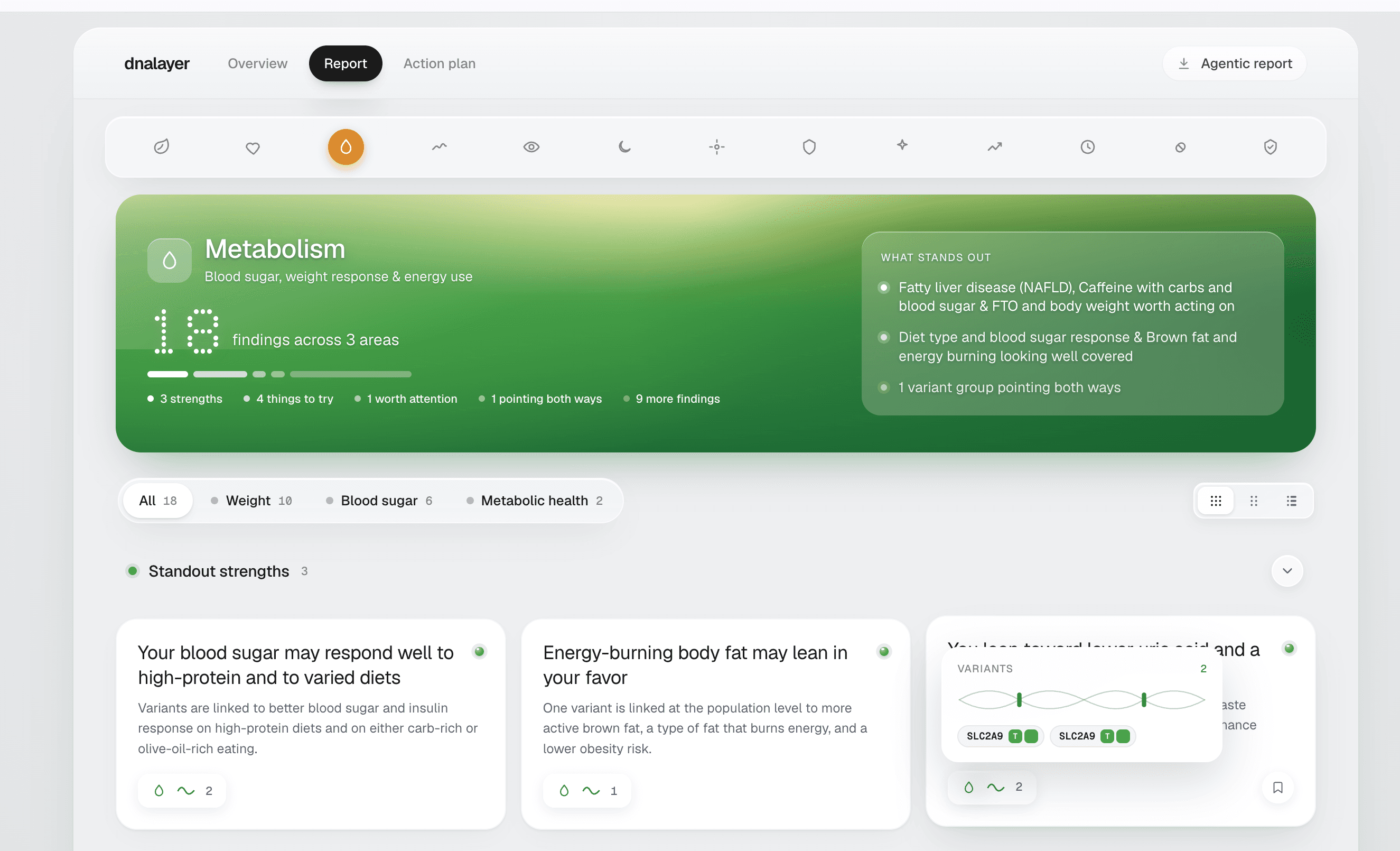
DNA Layer first parses and matches supported markers in deterministic software. It applies a curated evidence contract and clinical safety floor, then organizes findings into thirteen consumer health areas.
The full layer adds strengths, things to try, findings worth attention, an action plan, citations, and a report designed for follow-up in Claude, ChatGPT, or another AI assistant.
Four realistic paths
This is a job-based shortlist, not an affiliate ranking. Promethease remains a valid choice for its stated purpose. The alternatives are different products, not drop-in clones, and a longer report does not establish stronger evidence or better clinical usefulness.
| Path | Best when you want | Output and access model | Main boundary |
|---|---|---|---|
| Keep Promethease | A dense, searchable report tied to SNPedia entries and their cited literature. | One-time emailed report. Its current product page lists a per-report price and a smaller charge for an additional file. | Informational, not clinical; volume and citation count do not grade every association for actionability. |
| DNA Layer | A prioritized health layer, evidence context, limitations, and an action plan. | Free personalized preview; paid full layer and agentic report export. | Curated supported findings rather than an exhaustive SNPedia-style dump; informational, not diagnostic. |
| Genetic Genie | Focused Methylation and Detox profiles from consumer exports or supported VCF files. | Focused web report pages rather than a broad stored-genome workspace. | The cited Detox output is a narrow panel, not a complete consumer health interpretation. |
| Sequencing.com | A stored genome account, broad provider/file compatibility, and an app marketplace. | Free data upload; report and feature access varies by app. | Evaluate the specific marketplace app’s output, permissions, and price as well as the platform. |
The important difference is the job you want done
Choose based on the output, not the length of the variant list. A larger list can expose more entries while making it harder to tell which ones have strong evidence, which are common traits, and which need confirmation.
- For SNPedia-style exploration: Promethease is purpose-built around retrieving and browsing those linked entries.
- For prioritization and an action plan: DNA Layer is designed to reconcile evidence into health areas and make limitations visible beside findings.
- For a general chatbot workflow: use a verified, cited report as context rather than asking the model to interpret the original raw file unaided.
Evidence breadth is not the same as evidence strength
A paper mentioning a variant does not automatically make the association causal, replicated, large enough to matter, or appropriate for action. FDA guidance notes that direct-to-consumer services may disagree because they test different variants and apply different interpretations.
DNA Layer separates clinical classifications, pharmacogenomic guidance, and population-level associations instead of treating every source as equivalent. Its safety floor checks sources including ClinVar, ClinGen Actionability, CPIC, FDA pharmacogenomic labels, and PharmGKB. Read the full evidence methodology.
Privacy: compare the original file and what remains
Promethease says it deletes the DNA file and report immediately after sending the report to the user’s email; an upload that never generates a report is deleted after 24 hours. DNA Layer takes a different route: it reads the original file locally in the browser and does not intentionally retain it, while supported marker data and derived findings remain private for account access. Deleting the upload and retaining no genetic information are not the same claim.
| Service | Original-file flow | Report or derived data | Deletion qualification |
|---|---|---|---|
| DNA Layer | Read locally in the browser; the original full file is not intentionally retained by DNA Layer. Original raw file not retained in the browser-based upload flow. | Supported marker data, evidence records, and generated findings are stored privately for account access. | Deletion is available by request; data no longer needed is deleted or irreversibly de-identified, subject to legal needs and normal backup expiry. |
| Promethease | The DNA file is uploaded to Promethease servers to generate a one-time report. Deleted after report generation; an upload without a generated report is automatically deleted after 24 hours. | The server copy of the report is deleted after it is emailed; account information remains while the account exists. | Promethease and MyHeritage accounts can be deleted, but each account must be deleted separately. |
This records published commitments rather than independently auditing either service. See the complete DNA analysis privacy source matrix for methodology, access notes, source URLs, and limitations across seven tools.
What neither service can establish from a consumer file
A consumer genotype file is not comprehensive clinical sequencing. A missing marker does not rule out a condition, and an apparent pathogenic finding can be false positive. Use an appropriate confirmatory test and qualified professional before making decisions about treatment, medication, screening, or reproductive planning.
Frequently asked questions
What is the best Promethease alternative?
The best Promethease alternative depends on what you want to replace. DNA Layer is built for a prioritized health report and action plan; Genetic Genie for focused methylation and detox profiles; Sequencing.com for a stored genome and app marketplace. Keep Promethease if your priority is browsing a dense SNPedia-linked literature report.
Is DNA Layer the same as Promethease?
No. Promethease describes itself as a literature-retrieval system that connects raw DNA to material cited in SNPedia. DNA Layer uses a curated evidence panel, deterministic safety gates, health-area synthesis, and a separate explanation stage.
Does Promethease delete uploaded raw DNA?
Promethease's current privacy policy says raw DNA files and reports are deleted immediately after the report is emailed. Review the live policy before using the service because policies can change.
Which option is better for exploring individual SNPs?
Promethease may suit someone who specifically wants to browse SNPedia-linked entries marker by marker. DNA Layer is designed for people who want prioritized findings, health-area context, citations, limitations, and an action plan.
Is there a free Promethease alternative?
There are free entry points, but they are not equivalent. DNA Layer provides a free personalized preview before its paid full layer; Genetic Genie provides focused Methylation and Detox profiles; and Sequencing.com offers free data upload with report and app features that vary. Compare the actual output and retention model.
Can I use the same 23andMe or AncestryDNA file?
Often, yes. Promethease documents 23andMe and Ancestry report examples. DNA Layer supports original 23andMe, AncestryDNA, and MyHeritage exports. Genetic Genie and Sequencing.com also document those providers. The exact markers still differ by provider and chip version, so compatibility does not guarantee equal report coverage.
Can a Promethease alternative diagnose a condition?
No. Consumer raw-data reports are informational. Findings can be incomplete or false positive and may need confirmation through an appropriate clinical test before treatment, medication, screening, or reproductive decisions.
Sources and product documentation
- Promethease: report scope, supported-provider examples, price, and samples
- Promethease: service description, retention, and privacy policy
- Genetic Genie: Detox Profile scope, supported files, and retention
- Sequencing.com: supported providers and sequencing files
- Sequencing.com: Privacy Forever policy
- DNA Layer: evidence and safety methodology
- DNA Layer: privacy policy
- U.S. FDA: Direct-to-Consumer Tests
- NHGRI: third-party raw-data interpretation and confirmation
See your file as a prioritized health layer.
How responsible raw DNA interpretation worksCompare more 23andMe raw-data analysis tools
Choose your DNA provider